Why Fungi?
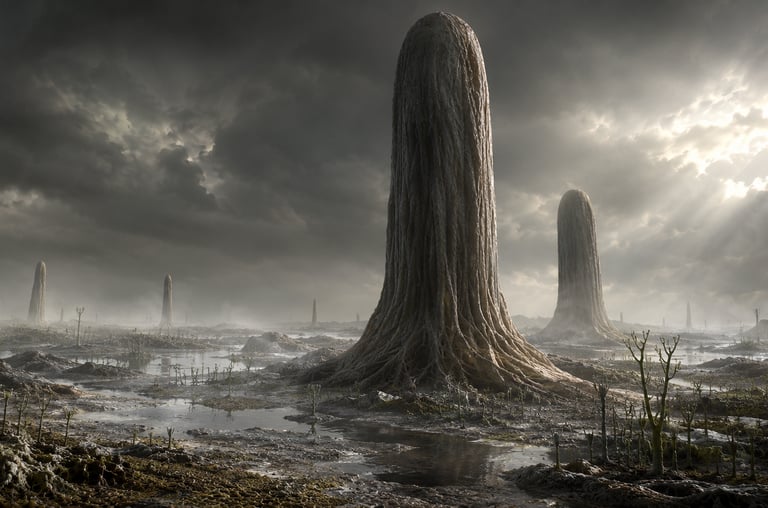
Prehistoric ancestors of modern fungi called Prototaxites emerged more than 400 million years ago, during the Silurian–Devonian transition, when Earth’s terrestrial ecosystems were still sparse, strange, and dominated by microbial crusts, primitive plants, and early fungi-like life.
Fungi are among Earth’s ancient terrestrial pioneers. Long before modern forests or animals transformed the continents, fungi helped shape early land ecosystems. These organisms faced a harsher planet: stronger ultraviolet stress, limited nutrients, desiccation, and unstable surface conditions. Over deep evolutionary time, fungi developed remarkable survival strategies, including robust DNA repair systems, resistant spores, protective pigments, metabolic flexibility, and the ability to recycle complex matter. The emerging field of Astromycology asks how these ancient adaptations can inform the biological future of space exploration.
Ancient Origins
Future Allies
Where humans go, fungi follow.
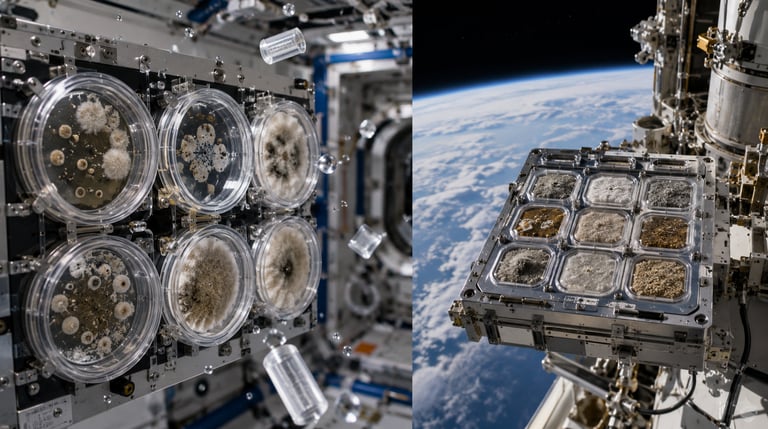
Despite our best efforts to keep spacecraft clean, fungi have been found growing aboard the International Space Station. More astonishing still, some fungal species have survived prolonged exposure to the open space environment, enduring intense radiation, vacuum, desiccation, and extreme temperature shifts.
Their ability to persist is not accidental. The traits that helped fungi survive and colonize the hostile landscapes of ancient Earth may also make them among the most important organisms for humanity’s future beyond it.